While all children need guidance in developing emotional regulation skills, some learners benefit from more intensive instruction and support. This may include learners with disabilities such as autism, ADHD, and intellectual disabilities, as well as learners who are experiencing specific challenges and need extra support to manage emotions and behavior.
For special education teams, writing meaningful self-regulation goals for individualized education programs/plans (IEPs) starts with understanding the unique learner, including their strengths, needs, environment, and the skills underlying what we see on the outside. While regulation is one of the most common areas of need in special education, school-based interventions, and therapeutic services, it can also be one of the most challenging areas to assess and develop goals around.
Regulation supports are frequently documented through individualized plans, including:
- Individualized Education Plans (IEPs)
- Section 504 Intervention Plans
- Individualized treatment plans
- Positive Behavior Support Plans (PBSPs)
- Behavior Intervention Plans (BIPs)
Whether you’re developing a new plan or updating existing goals, the most effective regulation-focused goals start with a clear understanding of a learner’s current strengths and needs.
Gather Data: The Story Behind the Skills
Before writing goals, determine a learner’s “present level of performance.” One of the most important things to remember is that behavior alone does not tell the whole story. What we see on the outside is the result of many underlying skills and experiences, including development, executive functioning, sensory processing, communication, and access to instruction or support.
You need to take a closer look.
To build a complete picture, gather information from multiple sources. Observations, learner input, and caregiver perspectives offer invaluable information about regulation strengths and challenges, including how they show up across settings. Screeners and informal assessments can also provide valuable data to help you dig deeper into social-emotional competencies on years when the IEP does not follow a full evaluation (occurs every three years in the USA).
The Devereaux Student Strengths Assessment-Mini (DESSA-mini) is one go-to social emotional learning (SEL) screener we find valuable to use for pre and post data, and we have a DESSA-Zones Crosswalk available here!
Data Collection Tools Included in The Zones Curriculum
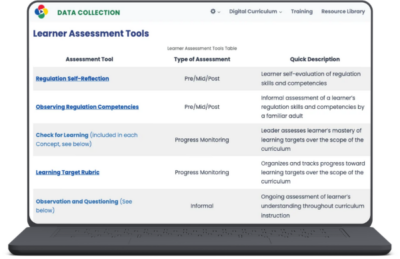
Any good baseline data collection tool should do more than identify areas for growth. It should help guide instruction and make progress monitoring manageable over time.
The Zones of Regulation® Curriculum is a widely used, research-based approach for developing regulation skills, including self and co-regulation, and broader social-emotional competencies. It can be used for proactive direct instruction within special education services, interventions, and therapeutic support both in and out of school.
Rather than piecing together resources from multiple programs, many teams find it helpful to use a curriculum that includes both instructional materials and assessment tools designed to work together.
Here are several data collection tools you’ll find in The Zones Curriculum:
Regulation Self-Reflection — Pre/Mid/Post
Learner self-evaluation of regulation skills and competencies.
Observing Regulation Competencies — Pre/Mid/Post
Informal assessment of a learner’s regulation skills and competencies by a familiar adult.
Check for Learning — Progress Monitoring
Included in each Curriculum Concept (or unit), this tool helps leaders assess a learner’s mastery of learning targets over the scope of the curriculum.
Learning Target Rubric — Progress Monitoring
Organizes and tracks progress toward learning targets over the scope of the curriculum.
In addition to these learner-based assessments, you’ll also find a Zones Climate Rubric to help you, the facilitator, set and monitor goals around ways you’re supporting and reinforcing regulation within your environment.
Tips for Writing SMART Self-Regulation Goals
Once you have a clear picture of a learner’s current skills, you can begin drafting meaningful SMART goals: Specific, Measurable, Achievable, Relevant, and Time-bound. Here are a few best practices to integrate:
- Keep it bite-sized rather than broad. Regulation develops over a lifetime. Instead of aiming for mastery, focus on the next achievable step on a learner’s developmental progression.
- Target the skill, not the curriculum. We discourage you from naming The Zones or including Zones-specific language into the goals. Goals should center around growing competencies in regulation and social emotional learning, not mastery of The Zones concepts.
- Include necessary supports. It is important to consider access to visuals, language prompts/cues, triggers (and sparks), and regulation tools when creating support plans as a road map for supportive adults to follow for consistency.
- Involve learners in developing goals. Rather than using societal “norms” as a basis for goals, collaborate with learners in developing their own authentic goals that are meaningful for them. This also helps with buy in for instruction moving forward!
Sample SMART IEP Goals for Self-Regulation
These example goals are directly aligned to the learning targets and lessons within The Zones of Regulation Curriculum.
Goal 1: Building Interoceptive Awareness
[Learner] will name one or more body signals they experience in relation to at least four emotions (Zones) in out of opportunities.
Goal 2: Identifying and Communicating Feelings
Given a check-in system and routine (such as a Zones Check-In), [Learner] will verbally or non-verbally identify and/or communicate their feelings using emotional vocabulary or naming system (Zone) in out of opportunities.
Goal 3: Using Regulation Tools
Given visual/verbal prompting and access to regulation tools (Zones Toolbox), [Learner] will select and use a tool/strategy to regulate in a real-time situation in out of opportunities.
Goal 4: Reflecting on Regulation
[Learner] will identify at least one situation within the day/week in which they would have benefited from using a regulation tool in out of opportunities.
Transforming Goals into Growth
Self-regulation is a skill that develops over time. By starting with a clear picture of a learner’s strengths and needs, IEP teams can create goals that support meaningful instruction and growth. Small and achievable steps, like identifying a feeling, noticing a body signal, or trying a new regulation tool, can be game changers for learners’ growth, success, and well-being in school and beyond.
Want a closer look at The Zones of Regulation Curriculum and the tools and resources included? Join a live curriculum demo or watch the recorded demo anytime to explore the curriculum and see how it can support regulation instruction, assessment, and progress monitoring.