As one of our Zones Champions, a first-grade teacher wisely noted, “We don’t teach anything important just once!” underscoring the value of using The Zones of Regulation Digital Curriculum year after year.
Growing from Co-Regulation to Self-Regulation
When we think about teaching regulation, it’s helpful to remember that it is a development skillset that takes time and support to foster, just like learning to walk or read. A child who first learns to co-regulate with supportive adults such as parents, caregivers, teachers, and therapists, will develop the foundational skills to self-regulate more easily in the future.
The Zones of Regulation simplifies co-regulation by providing a shared framework—taught through common language, visuals, and practices—that help both learners and supporting adults develop emotional awareness and communication skills. It also provides an easy-to-use system for managing feelings and energy in any situation. Teaching and reinforcing these skills with learners over multiple years nurtures their growth in communication, metacognition, and emotional regulation.
The Zones of Regulation Digital Curriculum’s scope and sequence is designed to provide opportunities to revisit, reinforce, and deepen learning throughout learners’ formative years. It equips you with actionable tools to co-regulate with learners in the moment and foster self-regulation over time.
How to Reinforce Self-Regulation Skills with The Zones Curriculum
The updated Zones of Regulation Curriculum is organized into “Concepts,” which are like units full of resources that can be taught over time. Within each concept, you have flexibility to best introduce and revisit the content using components including the Interactive Presentation, Group Activity, and Geared Activities. Use each concept’s formative assessment (Check for Learning) to assess what instruction is needed for your learners, and gauge to what depth you will extend learning as they grow and develop.
3 Strategies for Teaching The Zones Beyond Year One
- Pare Down the Interactive Presentation: Rather than re-teaching all slides in the Interactive Presentation, do a focused review of important topics, Pair & Share discussions, and digital games.
- Vary Your Activities: The Zones Curriculum has 100+ differentiated activities that make it easy to revisit and extend skills in new ways over the years.
- Adjust Your Instructional Time: As you strengthen regulation over the years, you may spend less time on directly teaching Zones lessons and more time on reviewing and reinforcing regulation skills in your Zones Climate.
Supporting Growth Across Grade Levels
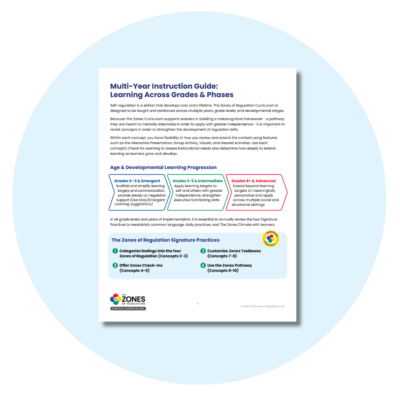
Here’s how we can think about the learning progression across ages and/or developmental phases:
Grades K-2 and Emergent Learning: Scaffold and simplify learning targets and communication, provide steady co-regulation support. (Use The Zones Curriculum’s Early/Emergent Learning suggestions)
Grades 3-5 and Intermediate Learning: Apply learning targets to self and others with greater independence, strengthen executive functioning skills.
Grades 6+ and Advanced Learning: Extend beyond the learning targets to meaningfully personalize and apply across multiple social and situational settings.
In all grade levels and years of implementation, it is essential to review the core Zones of Regulation practices (what we refer to as “Signature Practices”) on a yearly basis to reestablish common language for co-regulation, reinforce key skills, and promote a safe and inviting Zones Climate with learners.
Want a Closer Look?
Watch our Youtube video on preparing for year 2 of teaching The Zones of Regulation Curriculum.
Download this FREE Multi-Year Instruction Guide here to learn more about how it works!